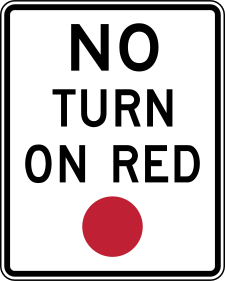
No Turn on Red Sign
Last updated:
A white rectangle reading NO TURN ON RED removes a permission that drivers in most of the country take for granted. By default many turns on red are allowed after a stop, but this regulatory sign cancels that allowance at the specific intersection where it is posted. Because it is the exception, it is easy to forget, and that is exactly when it catches drivers out.
What it means
This sign means you may not make a turn while the traffic light is red at this intersection, even after coming to a complete stop. You must wait for a green signal before turning in the direction the sign governs, usually a right turn but sometimes a left from a one-way street. As a regulatory sign it is an enforceable command, not a suggestion.
Why this sign exists
Turning on red is normally allowed because it keeps traffic flowing, but at certain intersections it creates unacceptable risk, so engineers post this sign to override the default. The reasons are specific: heavy pedestrian crossings, limited sight distance where a turning driver cannot see oncoming traffic, complex multi-phase signals, or conflicts with light-rail or bicycle movements. A white vertical rectangle with black or red lettering marks it as regulatory, the family of signs that state the law, distinct from yellow warning signs that merely caution. The vertical white rectangle is the standard format for rules about movement and turns, so its shape and color tell a driver to obey before they have even read every word. By naming the prohibition only where it matters, the sign keeps the convenient default in place everywhere else.
Where you see it
You find it at busy downtown intersections with heavy foot traffic, at crossings with blind approaches or odd angles, near schools, hospitals, and transit stops, and where signals have dedicated pedestrian or rail phases. It is mounted on or near the signal so it governs the lane it faces. Some versions apply only during certain hours, shown on an added time plate.
Real driving scenarios
- At a crowded city corner you stop on red, notice the NO TURN ON RED sign, and wait for green rather than nudging into the crosswalk full of pedestrians.
- A sign with a time plate forbids the turn only during school hours, so you check the times before deciding whether you may turn.
- On a one-way street the sign forbids a left turn on red, a less familiar version of the same rule, and you wait for the green.
What happens if you ignore it
Turning on red where it is banned puts vehicles into the path of pedestrians, cyclists, or cross traffic precisely at the spots where engineers judged the move too dangerous, so the crash risk is concentrated and real. Legally this is a clear violation: turning against the posted prohibition can bring a citation for disobeying a traffic control device or an improper turn, with fines and license points that vary by state. If the unlawful turn causes a collision, the turning driver is typically found at fault, with the resulting liability and insurance consequences. Cameras at some intersections enforce the prohibition automatically.
DMV exam trick questions
The phrasings that catch people out on the written test:
If there are no cars or pedestrians coming, may you turn on red where this sign is posted?
No. The prohibition is absolute at that intersection regardless of how clear the way looks; you must wait for green.
Does turning on red after a full stop satisfy this sign?
No. Stopping does not grant permission; the sign forbids the turn on red entirely, stopped or not.
This is a yellow warning sign. True or false?
False. It is a white regulatory sign stating an enforceable rule, not a yellow caution about a hazard.
How it compares to similar signs
- vs Right turn signal or arrow: A green or red arrow controls turning by signal phase, while the NO TURN ON RED sign is a standing rule that bans the turn whenever the light is red.
- vs No-right-turn sign: A no-right-turn sign bans the turn at all times, whereas NO TURN ON RED bans it only while the light is red and permits it on green.
- vs Yield sign: Yield asks you to give way and proceed when clear; this sign forbids the move outright on red regardless of whether the way is clear.
Memory aid
Red means stay: this sign nails the red so you cannot sneak the turn.
State-by-state notes
Right turn on red is allowed by default in most states after a full stop, but some cities (and certain states moving toward restricting it) ban it more broadly, so the default itself can vary, and this sign always overrides whatever the local default is.
Common mistakes
- Turning on red anyway because the intersection looks clear
- Assuming a complete stop earns permission to turn on red here
- Overlooking a time plate and turning during the restricted hours
Keep studying this topic
No Turn on Red Sign FAQ
Can I turn on red if no one is coming?
No. Where this sign is posted the prohibition is absolute, so you must wait for a green light no matter how clear the road looks.
Is this a warning or a regulatory sign?
It is a regulatory sign, a white rectangle stating an enforceable rule, not a yellow warning about a hazard.
Does the rule ever apply to left turns?
Yes. On a one-way street turning onto another one-way street, the sign can prohibit a left turn on red as well as a right.
What if the sign has a time plate?
Then the prohibition applies only during the hours shown; outside those hours the normal turn-on-red rules return.
What happens if I turn on red where it is banned?
You can be cited for disobeying a traffic control device, and if a crash results you are likely to be found at fault, with points and insurance effects.