DMV Questions Explained
The most common types of DMV test questions, grouped by topic, each with the correct answer and a plain-language reason. Learn the rule, not just the letter.
Last updated:
Sites that just throw questions at you train memory, not understanding. The official written test rephrases everything, so the only thing that travels with you into the exam room is knowing why an answer is right. Every example below is built around that idea: read the question, decide your answer, then check the reason. The questions are original educational examples that mirror the categories every state tests.
Most-asked questions, explained in depth
The tricky ones drivers search for most, each with the answer, why the common wrong choices are wrong, and a memory tip.
- When Is the Road Most Slippery?During the first 10 to 15 minutes of light rain, after a dry spell.
- What Does a Pennant Sign Mean?It marks the beginning of a no-passing zone.
- What Does a Flashing Yellow Arrow Mean?You may turn, but you must yield to oncoming traffic and pedestrians first.
- When Should You Use Low Beam Headlights?In fog, rain, or snow, and whenever you are near other traffic.
- What Should You Do at a Four-Way Stop?Stop fully, then yield to whoever arrived first; ties go to the driver on the right.
Road Signs
Sign questions reward pattern recognition. Once you know that shape and color carry meaning, an octagon for stop, a yellow diamond for warning, you can answer most of them on sight.
- Road Signs
1. You are driving in the lane where this sign is posted. What must you do?
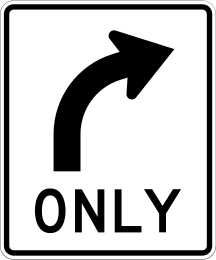
- Turn right; the lane is for right turns only
- Continue straight only
- Merge left immediately
- Stop and wait for a green arrow
Why: A lane-use control sign with a curved arrow and the word ONLY means every vehicle in that lane must make the indicated turn. Change lanes before the intersection if you want to go straight.
- Road Signs
2. A white rectangular sign reading a number such as 55 indicates:
- The minimum following distance
- The road's name
- The number of lanes ahead
- The maximum legal speed under ideal conditions
Why: A white regulatory speed limit sign shows the maximum speed allowed under ideal conditions. You must drive slower when weather, traffic, or road conditions require it.
- Road Signs
3. A solid yellow line on your side of the center plus a 'Do Not Pass' sign means:
- You may pass if traffic is light
- Passing is permitted at night only
- You may not pass in this zone
- You may pass only large trucks
Why: A no-passing zone, marked by a solid yellow line on your side and often a DO NOT PASS sign, prohibits passing because sight distance is limited and passing is unsafe.
- Road Signs
4. What does this sign tell drivers?

- The left lane ends ahead; merge right
- The road curves left
- A new lane is added ahead
- Trucks must use the left lane
Why: The lane-ends symbol warns that a lane is about to end. Traffic in the ending lane must merge into the continuing lane; drivers in the through lane should allow room.
- Road Signs
5. This orange sign means:
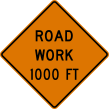
- Road work is ahead; slow down and watch for workers and equipment
- A detour is required
- The road is permanently closed
- A school zone is ahead
Why: Orange diamond-shaped signs mark temporary work zones. This one warns of road work ahead, in this case 1,000 feet away. Reduce speed and obey workers and flaggers.
- Road Signs
6. What does this sign tell you?

- The road makes a sharp change of direction; follow the arrow
- One-way traffic only
- Merge into the next lane
- End of the roadway
Why: Chevron alignment signs mark a sharp curve or change of direction. They are placed on the outside of the curve; slow down and follow the direction of the chevron.
- Road Signs
7. What does this sign warn drivers of tall vehicles about?

- A low overhead clearance of 12 feet 6 inches ahead
- A 12.6 percent downgrade
- A weight limit of 12.6 tons
- A bridge 12 miles ahead
Why: The low clearance sign shows the maximum height that can safely pass under the structure ahead. Vehicles taller than the posted clearance must use another route.
- Road Signs
8. A white X-shaped sign with 'RAILROAD CROSSING' (a crossbuck) means:
- The crossing is closed
- Trains never use this track
- Yield to any approaching train
- Stop only at night
Why: The crossbuck marks the railroad crossing itself and functions like a yield sign: you must yield to any approaching train and not cross until the way is clear.
Traffic Signals
Signal questions test what each light and arrow requires of you, including the flashing and arrow indications that trip up new drivers.
- Traffic Signals
1. A steady (solid) red traffic light means:
- Stop and remain stopped until the light turns green
- Slow down and proceed with caution
- Stop, then continue without waiting
- Yield only to pedestrians, then go
Why: A steady red light requires a full stop behind the stop line or crosswalk. You must wait until the light turns green; a right turn on red is allowed after stopping only when the way is clear and no sign prohibits it.
- Traffic Signals
2. A flashing yellow X over a traffic lane indicates:
- The lane is permanently closed
- The lane is open only to buses
- Stop before the lane
- Use the lane only to make a left turn, with caution
Why: A steady or flashing yellow X over a lane signals that the lane is for turning or that you should clear it because its status is changing; use it only as directed and with caution.
- Traffic Signals
3. Flashing yellow beacons posted at a school zone sign mean:
- Reduced school-zone speed limits are now in effect
- Ignore them outside of summer
- The school is permanently closed
- You may pass stopped school buses freely
Why: Flashing beacons at a school zone indicate that the lower school-zone speed limit is in force, usually at arrival and dismissal times. Slow down and watch closely for children.
- Traffic Signals
4. A red X displayed over a freeway lane means:
- The lane is open for carpools only
- You may use the lane with caution
- Do not drive in that lane
- The lane is reserved for trucks
Why: Overhead lane-control signals manage reversible or incident lanes. A red X means the lane is closed to you and you must not drive in it; a green arrow means the lane is open.
- Traffic Signals
5. A green arrow pointing left at a traffic signal means:
- You may turn left and oncoming traffic is stopped for you
- You must yield to oncoming traffic before turning
- Left turns are prohibited
- Stop and wait for a green ball
Why: A green arrow gives you a protected turn in the direction of the arrow; oncoming and conflicting traffic is held by a red signal, but you must still watch for pedestrians.
- Traffic Signals
6. When a traffic signal is completely dark due to a power outage, you should:
- Drive through without slowing
- Assume you have the right-of-way
- Treat the intersection as an all-way stop
- Wait for police before moving
Why: A dark or non-functioning signal must be treated as a four-way (all-way) stop. Each driver stops and proceeds in turn based on order of arrival and right-of-way rules.
- Traffic Signals
7. A steady red arrow at a signal means:
- You may turn in the arrow's direction after yielding
- You must stop and may not turn in the arrow's direction
- Proceed straight only
- Turn is permitted after honking
Why: A red arrow means stop; you cannot make the movement shown by the arrow until it turns green. In most states you may not turn on a red arrow even after stopping.
- Traffic Signals
8. A steady red arrow signal means:
- You may not turn in the direction of the arrow until the signal changes
- Turn in the direction of the arrow after yielding
- Proceed straight through only
- Stop, then turn in the arrow's direction if the way is clear
Why: A steady red arrow means stop: you may not make the movement shown by the arrow. Wait until it turns into a green arrow or the signal otherwise permits the turn.
Right-of-Way
Right-of-way is about who must yield, not who has permission to go. These questions hinge on order at intersections, roundabouts, and crosswalks.
- Right-of-Way
1. At a four-way stop where two vehicles arrive at the same time, the right-of-way goes to:
- The faster vehicle
- The vehicle on the right
- The vehicle on the left
- The larger vehicle
Why: When two vehicles reach an all-way stop at the same time, the driver on the left yields to the driver on the right. If unsure, proceed cautiously and communicate.
- Right-of-Way
2. If you and an oncoming car both intend to turn left at an intersection, you should:
- Turn left of each other, passing on the left side
- Turn in front of each other
- Wait for the other to go first always
- Make a U-turn instead
Why: When two opposing vehicles both turn left, they normally pass to the left of one another (front-to-front), keeping the intersection clear and visibility open.
- Right-of-Way
3. Vehicles already in a roundabout have the right-of-way over:
- No one
- Pedestrians on the sidewalk
- Emergency vehicles
- Vehicles waiting to enter
Why: Traffic circulating in a roundabout has the right-of-way. Entering drivers must yield and wait for a safe gap before merging in, traveling counterclockwise.
- Right-of-Way
4. When entering a road from a driveway or alley, you must:
- Yield to traffic and pedestrians on the road
- Proceed without stopping
- Assume traffic will stop
- Honk and pull out
Why: Traffic already on the roadway and pedestrians on the sidewalk have the right-of-way. Stop and yield before entering from a driveway, alley, or parking lot.
- Right-of-Way
5. When turning left at an intersection, you must yield to:
- Only vehicles behind you
- No one if you have a green light
- Oncoming traffic and pedestrians
- Vehicles turning right
Why: A driver turning left must yield to oncoming traffic that is close enough to be a hazard and to pedestrians in the crosswalk before completing the turn.
- Right-of-Way
6. At an uncontrolled intersection (no signs or signals), you should:
- Always go first
- Yield to the vehicle on your right
- Speed through
- Stop for 30 seconds
Why: With no signs or signals, slow down and yield to any vehicle that arrived first; if you arrive together, the vehicle on the right has the right-of-way.
- Right-of-Way
7. Pedestrians in a crosswalk have the right-of-way:
- Only at red lights
- Never
- Over turning and through vehicles
- Only when waving
Why: Pedestrians lawfully in a crosswalk have the right-of-way, and drivers turning or going straight must yield and allow them to cross safely.
- Right-of-Way
8. Emergency vehicles with lights and sirens active:
- Must yield to regular traffic
- Have the right-of-way over all other vehicles
- Should be ignored
- Only have priority at night
Why: Active emergency vehicles have the right-of-way. All other drivers must yield, pull to the right when safe, and stop until they pass.
Traffic Laws
These cover the everyday rules: turning, signaling, lane use, and the laws you are expected to follow without being reminded.
- Traffic Laws
1. When you see a stopped school bus with its red lights flashing and stop arm out on an undivided road, you must:
- Stop in both directions until the lights stop flashing
- Pass quickly on the left
- Slow to 10 mph and pass
- Honk to alert children
Why: On an undivided road, traffic in both directions must stop for a school bus loading or unloading children. Remain stopped until the red lights turn off and the stop arm folds in.
- Traffic Laws
2. When approaching a stop sign, you must stop:
- Anywhere within 50 feet
- Before the stop line, crosswalk, or edge of the intersection
- Only if other cars are present
- After entering the intersection
Why: You must stop behind the stop line; if there is none, stop before the crosswalk; if there is no crosswalk, stop before entering the intersection where you can see cross traffic.
- Traffic Laws
3. It is illegal to pass another vehicle when:
- You are within a marked no-passing zone or approaching a hill or curve
- The road is straight and clear
- Traffic is light
- The other car is slow
Why: Passing is prohibited where sight distance is limited, such as on hills, curves, near intersections, and in posted no-passing zones marked by a solid yellow line.
- Traffic Laws
4. Using a hand-held cell phone while driving is:
- Always allowed on highways
- Required for navigation
- Restricted or banned in many states, especially for texting
- Allowed only above 40 mph
Why: Most states ban texting while driving and many prohibit holding a phone at all. Use hands-free devices and avoid distractions that take your eyes off the road.
- Traffic Laws
5. An open container of alcohol in the passenger area of a vehicle is:
- Allowed for passengers only
- Generally prohibited under open-container laws
- Legal if the driver is sober
- Permitted on private roads
Why: Open-container laws generally prohibit open alcoholic beverages in the passenger compartment, regardless of who is drinking, to discourage impaired driving.
- Traffic Laws
6. The 'Move Over' law generally requires drivers to:
- Speed past emergency vehicles
- Slow down and, if possible, change lanes away from stopped emergency or service vehicles
- Stop completely on the freeway
- Turn on hazard lights and continue at speed
Why: Move Over laws protect police, tow operators, and other roadside workers. When safe, move over a lane; if you cannot, slow down significantly as you pass.
- Traffic Laws
7. When making a right turn, you should generally turn from:
- The far left lane
- The center lane
- Any lane that is open
- The lane closest to the right curb
Why: Right turns are normally made from the lane nearest the right curb or edge of the road into the corresponding lane, keeping turns tight and predictable.
- Traffic Laws
8. Turning on your turn signal before changing lanes is:
- Required to communicate your intent to others
- Optional in light traffic
- Only needed on highways
- Only for left turns
Why: Always signal before turning or changing lanes so other drivers and pedestrians know your intentions. Signal early enough to give others time to react.
Safe Driving
Safe-driving questions test judgment: following distance, hazards, weather, and how to react when conditions change.
- Safe Driving
1. The recommended minimum following distance under good conditions is often measured using the:
- One-second rule
- Ten-second rule
- Three-second rule
- Half-second rule
Why: The three-second rule gives a safe following gap: pick a fixed point, and if you reach it less than three seconds after the car ahead, you are too close. Increase the gap in poor conditions.
- Safe Driving
2. If you become drowsy while driving, the safest action is to:
- Pull over in a safe place to rest
- Open the window and keep going
- Drink coffee and speed up
- Turn up the radio and continue
Why: Drowsiness sharply slows your reactions. The only reliable fix is to stop in a safe location and rest; tricks like loud music do not prevent falling asleep.
- Safe Driving
3. On a slippery or icy road, you should:
- Drive at the normal speed limit
- Brake and accelerate gently and increase following distance
- Brake hard at each turn
- Follow closely to draft other cars
Why: On ice or snow, smooth, gentle inputs keep traction. Reduce speed, leave extra following distance, and avoid sudden braking, steering, or acceleration.
- Safe Driving
4. To reduce the danger of hydroplaning on wet roads, you should:
- Drive faster to push water away
- Slow down and avoid hard braking
- Use cruise control
- Brake hard in puddles
Why: Hydroplaning happens when tires ride on a film of water. Reduce speed in rain, keep tires properly inflated, and avoid sudden braking or steering.
- Safe Driving
5. If your vehicle begins to skid, you should:
- Steer in the direction you want the front of the car to go and ease off the accelerator
- Brake hard immediately
- Turn the wheel sharply opposite
- Accelerate to regain control
Why: In a skid, ease off the gas and steer gently in the direction you want to go. Avoid slamming the brakes, which can worsen the loss of control.
- Safe Driving
6. Before driving, adjusting your mirrors and seat helps you to:
- Save fuel
- Drive faster
- See clearly and reach the controls comfortably
- Avoid using signals
Why: Setting up mirrors, seat, and head restraint before you drive improves visibility and control and lets you react quickly without distraction.
- Safe Driving
7. When driving at night, you should dim your high beams when:
- Driving on any road
- Only in cities
- Never
- Within about 500 feet of an oncoming vehicle or following another car
Why: Switch to low beams when an oncoming vehicle is roughly 500 feet away and when following another vehicle, so you do not blind other drivers.
- Safe Driving
8. When approaching a curve, you should:
- Brake hard in the middle of the curve
- Accelerate into the curve
- Coast in neutral
- Slow down before entering the curve
Why: Reduce speed before you enter a curve, then maintain or gently increase speed through it. Braking hard mid-curve can cause a skid.
Speed Limits
Speed questions go beyond the posted number. The basic speed law, school zones, and work zones all change what is legal and safe.
- Speed Limits
1. The 'basic speed law' requires that you:
- Never drive faster than is safe for current conditions
- Always drive the posted maximum
- Drive at least the minimum at all times
- Match the fastest car
Why: The basic speed law says you must never drive faster than is safe for current conditions, even if that speed is below the posted limit, such as in rain or heavy traffic.
- Speed Limits
2. What does this sign indicate?
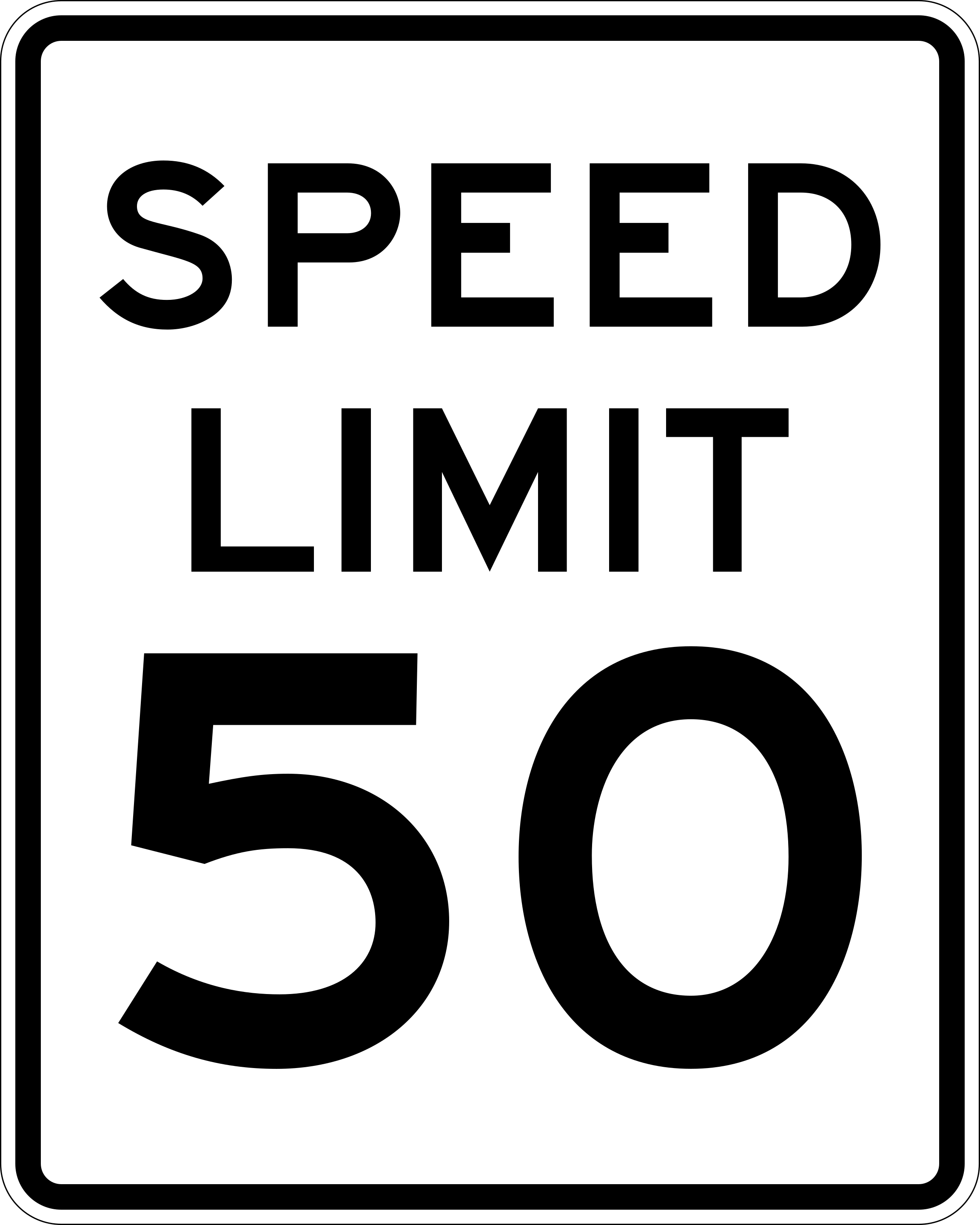
- The maximum legal speed is 50 mph in ideal conditions
- The minimum required speed is 50 mph
- A suggested advisory speed for the curve ahead
- The distance to the next exit is 50 miles
Why: A white rectangular SPEED LIMIT sign shows the maximum legal speed under ideal conditions, here 50 mph. Drive slower when weather, traffic, or visibility require it.
- Speed Limits
3. In a school zone when children are present, you should:
- Maintain highway speed
- Reduce speed to the posted school-zone limit and watch for children
- Speed up to clear the zone
- Ignore the limit if you are late
Why: School-zone speed limits are lower to protect children. Slow to the posted school-zone speed and be ready to stop when children are present or beacons flash.
Pavement Markings
Lines on the road are instructions. Color and pattern tell you where you may pass, change lanes, or stop.
- Pavement Markings
1. A solid yellow line on your side of the center line means:
- You may pass when clear
- Passing is allowed at night
- The road is one-way
- You may not pass across that line
Why: Yellow center lines separate opposing traffic. A solid yellow line on your side means passing is prohibited there; do not cross it to pass.
- Pavement Markings
2. A broken (dashed) yellow center line means:
- You may pass when it is safe and the way is clear
- No passing in either direction
- The road is closed
- Two-way traffic is prohibited
Why: A broken yellow center line indicates that passing is allowed in your direction when it is safe to do so and there is no oncoming traffic.
- Pavement Markings
3. A broken (dashed) white line between lanes means:
- Lane changes are prohibited
- You may change lanes when safe
- The lane is for buses only
- Stop ahead
Why: Broken white lines separate lanes of traffic moving in the same direction and indicate that you may change lanes when it is safe.
- Pavement Markings
4. Parallel white lines painted across the road at an intersection indicate:
- A bike lane
- A no-parking zone
- A railroad crossing
- A crosswalk for pedestrians
Why: Crosswalk markings show where pedestrians cross. Drivers must stop behind them and yield to people in the crosswalk.
Ready to test yourself?
Reading explanations builds understanding; timed practice builds recall. Put them together with a free state practice test.
Frequently asked questions
Are these the real DMV test questions?
No. These are original educational examples written to match the topics and format of state written tests. They teach the same rules the official test covers, but the wording is our own. Use them to learn, then take a full practice test for your state.
Why does every question include an explanation?
Memorizing answers does not transfer to the real test, which phrases questions differently. Understanding why an answer is correct means you can reason through any version of the question. That is why each item here shows the rule behind the answer.
How should I use this page to study?
Read one category at a time, cover the answer, and try to reason it out before checking. When the explanation surprises you, that is a topic to drill. Then take a timed practice test and review anything you miss.
Do DMV questions differ by state?
The core rules (signs, signals, right-of-way) are national and appear everywhere. Specifics like speed limits, BAC details, and passenger rules vary by state, so always pair this page with your own state practice test and handbook.